

Shifting the Narrative
Washington can now cut Europe off at every layer — frontier AI, intelligence software, missiles. Defence saw it coming years ago. The rest of the continent just caught up

On June 12th, the US effectively ordered Anthropic to ban foreign access to its newest models, Fable and Mythos. The block spared no one - even the Five Eyes allies, Britain, Canada, Australia and New Zealand, woke up on the same side of the wall as Russia and Iran. For Europe’s political class it was a genuine shock. The idea that America might one day switch off access to intelligence had been hypothetical until the afternoon it wasn’t.
It was not a shock to the people who run European defence.
The generals already knew
Defense leaders have been planning around this for two years, because they have already been on the receiving end for military systems: Washington slow-walked missile deliveries, held back Patriots, and made clear that permission to fire Western weapons into Russia could be pulled depending on how Putin retaliated. Britain’s Storm Shadow, which depends on American guidance systems and cartographic data, has been sitting unusable since late 2024. And the unreliability, even withdrawal, is only accelerating: a few weeks ago Trump announced he was pulling 5,000 of America’s 36,000 troops out of Germany and cutting what it keeps on call for Europe - fighter jets from roughly 150 to 100, all 8 aerial-refuelling tankers withdrawn, a carrier and a missile submarine redeployed. NATO’s own spokesperson called it “the end of an over-reliance on US forces.”
The growing disengagement from the US has sparked a massive shift inside European defence: to build our own alternatives, free of US components. Britain unveiled this week three prototype long-range missiles built with no American parts at all - MBDA’s “Crossbow” swaps in an in-house visual navigation system for the US guidance it would once have used. Ukraine’s own Fire Point, its largest missile and drone maker, is turning out ITAR-free strike drones and cruise missiles for the same reason — and has now flight-tested a ballistic missile meant to anchor a homegrown air-defence system, a potential answer to the Patriot.
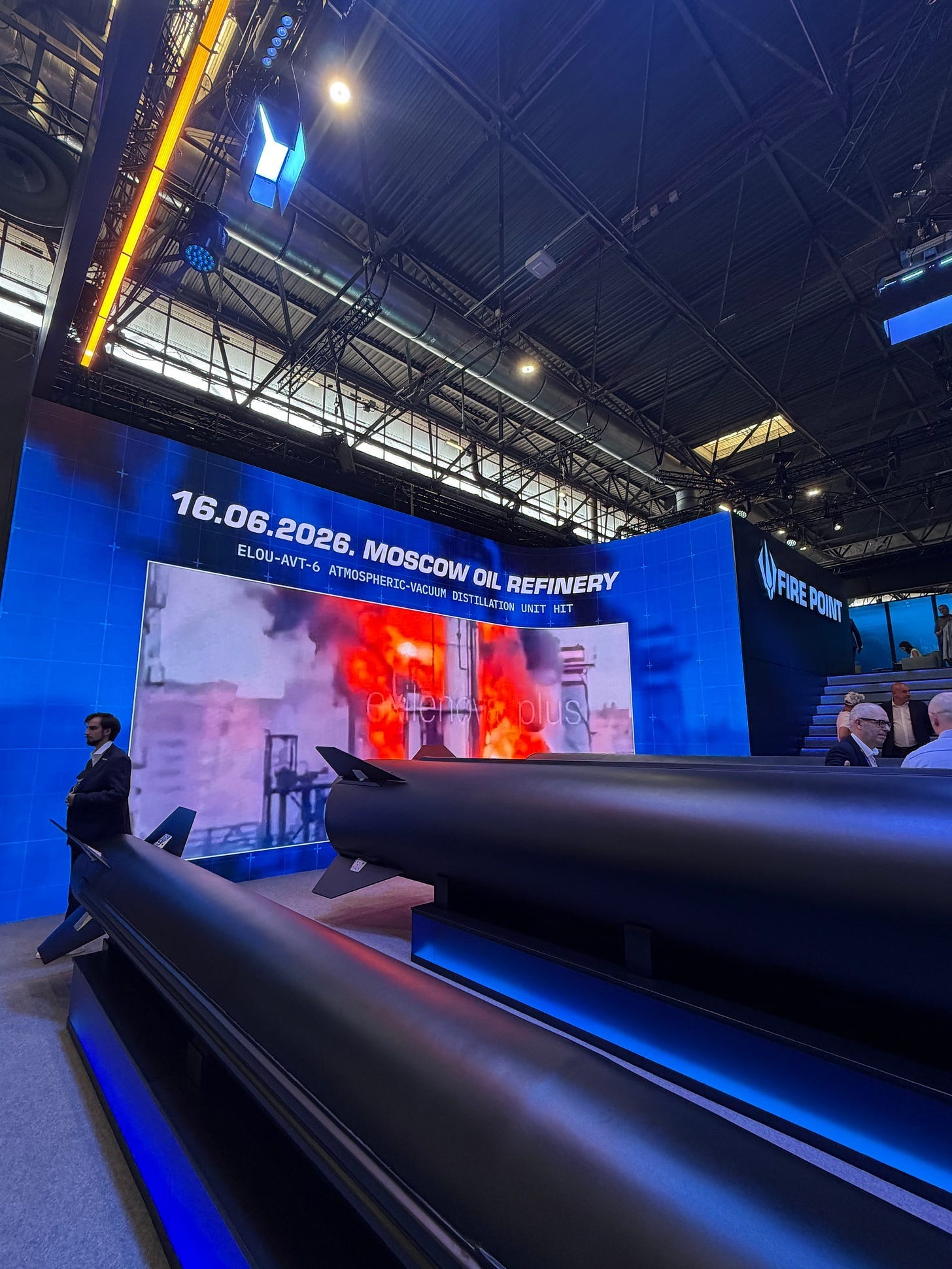
FirePoint dominated the Eurosatory show last week - showcasing its successful deep strikes missions on Russian territory.
Not anymore just a French reflex
The same instinct has now reached the software layer. France is replacing Palantir at the DGSI, its domestic intelligence service, with a homegrown firm, ChapsVision - around €300m in revenue against Palantir’s $5bn. It is a striking reversal: France was the first country outside the US to buy Palantir’s Gotham, after the 2015 attacks. Yet, you could still shrug it off, because France has always leaned sovereign and backing a national champion is what Paris does (remember when OVH was going to replace AWS or Qwant Google?).

The new David vs Goliath.
Harder to shrug off is who else is moving the same way: Germany’s domestic intelligence agency, the BfV, has signalled it will pick the same French firm over Palantir - already embedded in police forces in several Länder. Even Britain is reportedly weighing whether to drop Palantir from its large, historic NHS contract.
When countries with no national champion to protect start making the same call as Paris, it stops looking like a French chauvinistic reflex and starts looking like a direction of travel.
Fear is the wrong lesson
All of this is being sold to Europeans as fear: an unstable world, an unreliable ally, exposure on every side. It is accurate. It is also paralysing, and it casts rearmament as a bill to be paid rather than the opening it really is. What Europe actually needs is the opposite story, told on purpose - a positive narrative around defence renewal - because fear funds a budget line for a few years before the backlash sets in.
Because the genuinely exciting thing, underneath the instability everyone keeps invoking, is that the moment forces Europe to build strong champions in the frontier models, the software that runs on them, and a defence industry pushed to innovate again. Defence is a tremendous innovation power and has a long habit of producing the technology everyone later takes for granted. The internet began as a Pentagon network. GPS was built to steer warships and missiles before it guided anyone’s taxi. The voice assistant in every phone grew out of a DARPA project, and Bell Labs gave the transistor to the world on military contracts. A technological revolution and a redrawn world order have arrived together - a one-in-a-century alignment Europe can turn into large new winners rather than just a heavier defence bill.
Germany is the one country betting its next industrial chapter - arguably its whole economic future - on defence, treating rearmament not as a cost to be endured but as the foundation of its next set of champions for the 21st century. It voted through the largest defence budget in Europe and used the moment to revive an industrial base of carmakers, chemical works and precision engineering. Those budgets became a clear demand signal, and in a few years Germany has already produced some of the most exciting defence companies on the continent - Helsing, now valued at €17bn, and Stark at €3.5bn. Carmakers are rushing into the new ecosystem: the interceptor startup TYTAN is teaming up with Mercedes-Benz, Continental has paired with drone company 24Industries, and so on. Munich is now the hotspot for physical-AI innovation in Europe - as every ambitious founder in Europe is now opening a local team or eyeing a full relocation.
Germany has already shown what that looks like. Europe spent decades importing its security; this is the moment to build the global champions that sell it back to everyone else.
Yeah, Congress has been tightening ITAR on European cloud nodes since 2021. The real kicker is the compute choke: TSMC’s 4nm still needs ASML gear and Calnexa litho stacks. Europe’s AI sovereignty talk means nothing if we can’t print the chips.