It is common to think of Germany as the most exciting place in Europe to build a defense startup.
The numbers make the case on their own: In 2022, the country changed its constitution to create a €100 billion special fund for the Bundeswehr. In March 2025, it went much further and exempted all defense spending above 1% of GDP from its debt brake. In a country where the word for debt, Schulden, shares its root with the word for guilt, Schuld, that is no small thing. The defense budget is set to reach around €150 billion a year by 2029, roughly 3.5% of GDP, and Berlin has committed to building the largest conventional army in Europe.
In 2025 alone, Germany ordered around €85 billion of military equipment, more than the UK and Poland combined.
A large share of that money is going to new companies. Germany is the only EU country that has given startups contracts worth more than €1 billion, starting with the loitering munition frameworks awarded to Helsing and Stark, and Helsing alone has won at least three contracts of more than €500 million each. For a European defense founder, Germany is the market that can turn a startup into a prime, and do it fast.
But when a thesis becomes this consensus, it is worth stress-testing it. So let’s look at the strongest bear case against Germany as a defense power, and see how much of it holds up.
The Germans certify drones
The first argument of the bear case is regulation, and it is the one founders complain about most. Germany is famous for its notary stories, where founders and investors sit through hours of notarial readings before a deal can close, and yes, they are all true.
This regulation overkill extends to drone certifications, as Germany is the only country that requires military drones to be certified. Everywhere else, armies test drones in the field, buy the ones that work and order the next version a few months later. The logic is the one of ammunition: you judge a product by whether it hits the target, and you replace it as soon as something better appears. Germany applies the logic of aircraft instead, and puts each system through a formal certification process before troops can use it at scale. Stark and Helsing have both had to go through it, and the process takes months.
I would not overstate this point, though. The officials running the process are not trying to block anyone. They have a real interest in getting Stark and Helsing certified, and they tell the companies what they need to do. It remains a painful, expensive and, in my view, unnecessary process.
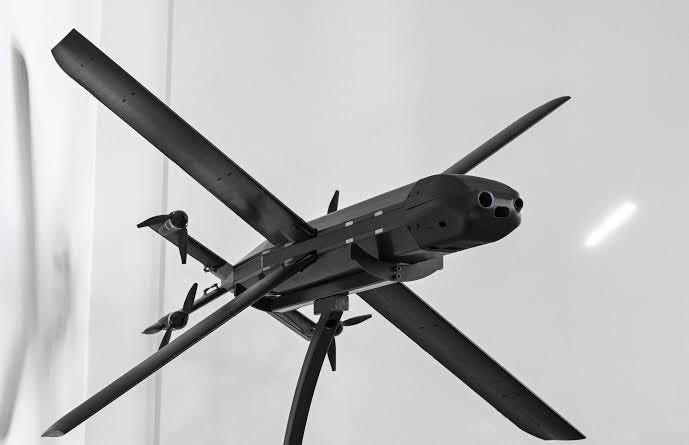
The HX-2 strike drone from Helsing - deployed in Ukraine yet until recently not fully certified for the German market.
The same instinct shows up in counter-drone defense. Since 2025, airports and critical infrastructure across Germany have been regularly overflown by drones, incidents German officials have linked to Russia’s hybrid warfare campaign. In October 2025, drone sightings shut down Munich airport two nights in a row. Yet while France has recently allowed critical infrastructure operators to neutralise drones over their own sites, German operators have to call the police. By the time they arrive, the drone is usually gone, and the offenses go unpunished. Airports, power plants and other critical infrastructure operators cannot act themselves.
Parliament signs every cheque
A major throwback is how procurement and contracts get done. Every defense purchase above €25 million needs a vote in the Bundestag’s budget committee. It goes back to the idea that the Bundeswehr is a parliamentary army, controlled by the Bundestag rather than the government, and Germans treat that principle as constitutional. After 1945, it was a sensible safeguard. Today, it sits uneasily with a government trying to rearm as fast as it can.
In practice, every new tranche of a contract goes back to parliament. When the budget committee approved Helsing and Stark’s loitering munition frameworks in February, up to €1 billion each, it also capped them, and any spending beyond the cap needs a fresh vote. A procurement officer who sees a system performing well cannot simply order more of it. The winners of a war economy are the products that scale fastest, and Germany has built a system where scaling depends on the parliamentary calendar. This is the real issue with the country, and because it is so deeply rooted, it is the one least likely to change.
The Bundeswehr buys most of its equipment through its central procurement agency. According to Keen’s report, the project leaders there carry significant personal accountability for their decisions and can face audits, legal challenges, disciplinary action and reputational damage if a purchase goes wrong. The authors argue that this pushes officials toward established suppliers with a proven delivery record, and away from younger companies with less-tested technology.
According to Resilience Media, Stark made the same point to the Bundestag in a November 2025 submission. It said project leaders face an “at least theoretical risk of personal liability” when they approve a military system for use. This creates a culture in which officials check everything several times to protect themselves, and it asked for that liability to be limited on newer procurement projects so approvals can move faster.
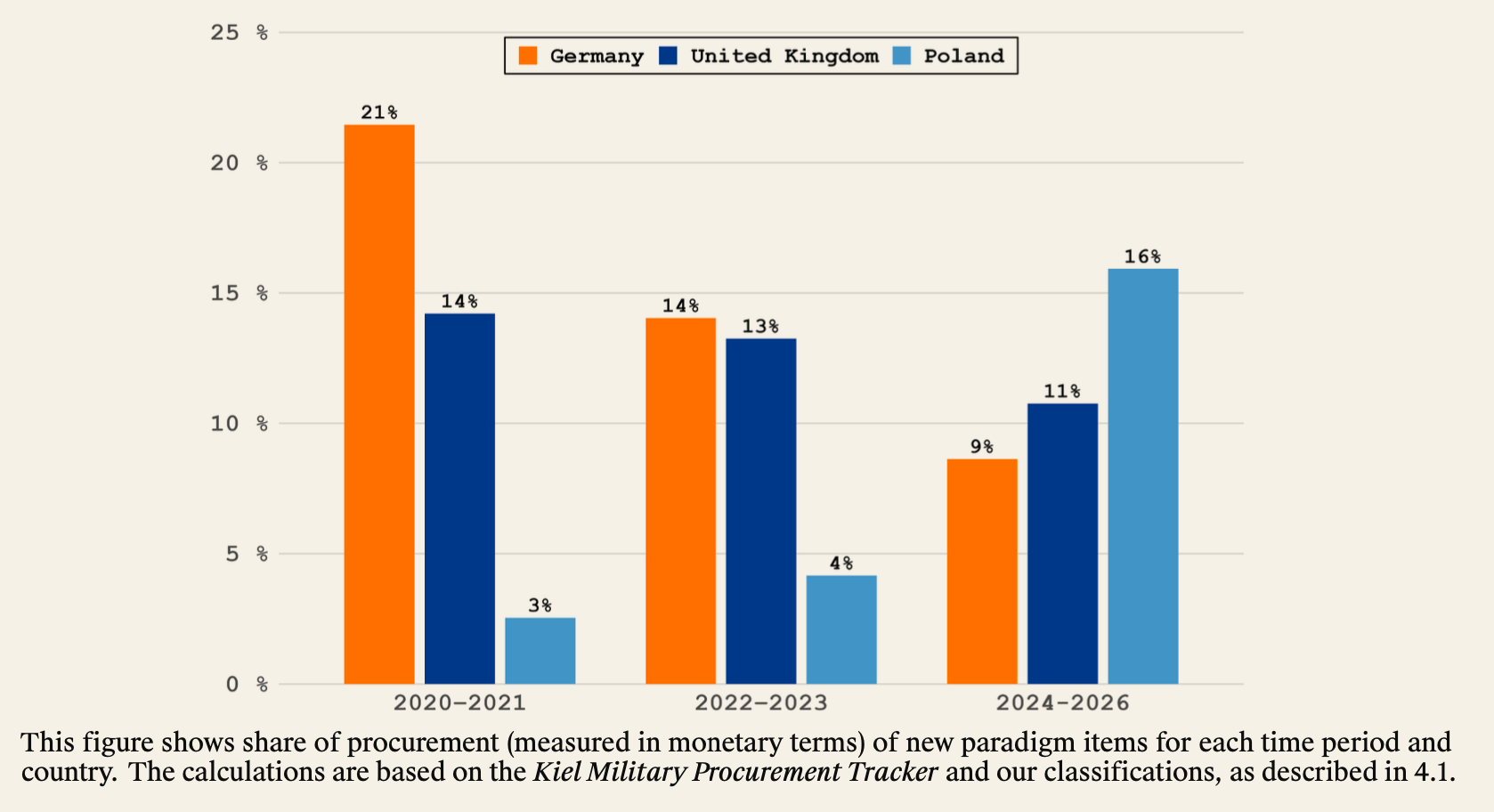
The result is that Germany spends more than anyone in Europe, but mostly on the systems it already knew how to buy - which rewards conventional vs new weapons. According to the Kiel Institut, drones, autonomous systems and counter-drone equipment now make up only 9% of German procurement, down from 21% five years ago.
There is no inherent reason why this should remain in the long-run. The FT recently covered the German guerilla unit that procures weapons at scale for Ukraine - sometimes as quickly as under two weeks. This muscle for pragmatic, fast procurement could inspire the rest of the Bundeswehr.
A closed door in the Gulf
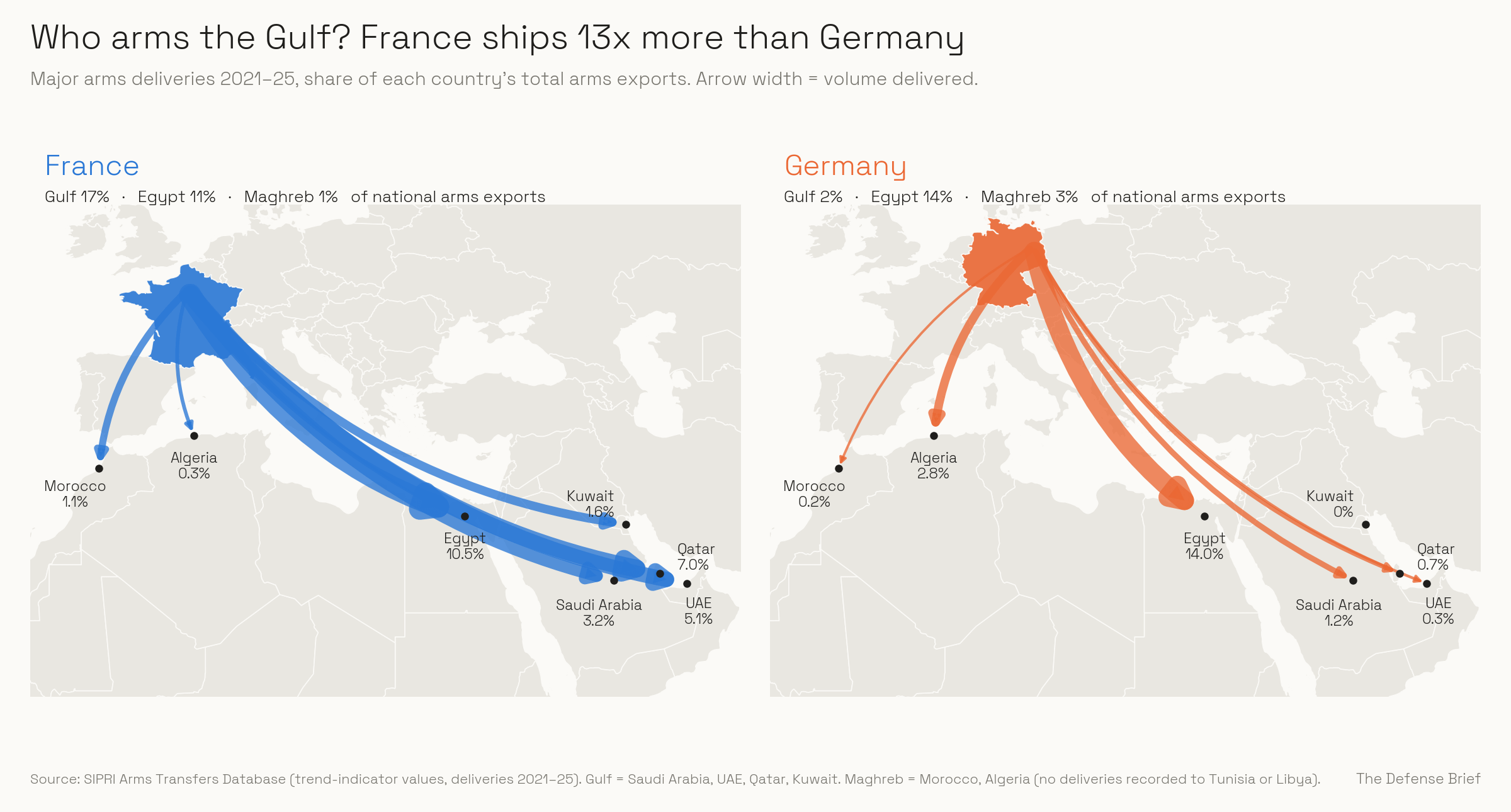
The third argument is exports. German export policy is unpredictable, especially toward the Middle East. Berlin blocked Eurofighter sales to Saudi Arabia for six years after the Khashoggi murder, and approvals for the region still depend heavily on the politics of the moment.
That is a shame, because the Middle East has been a relay of growth for many European defense startups, which have exported there quickly and successfully. This matters less for Germany’s large groups, which already sell to the region. But it puts German startups behind the French, whose decades of political ties to the Gulf give companies like Harmattan AI, Alta Ares or Comand AI a much easier path to those customers.
The counter-argument is that French startups look to the Gulf early because their own government is cash-strapped, while German startups have a great customer at home. But in the long run, German startups will also need growth outside their home market, and a closed door in the Gulf could weigh on their long-term success.
The black swan
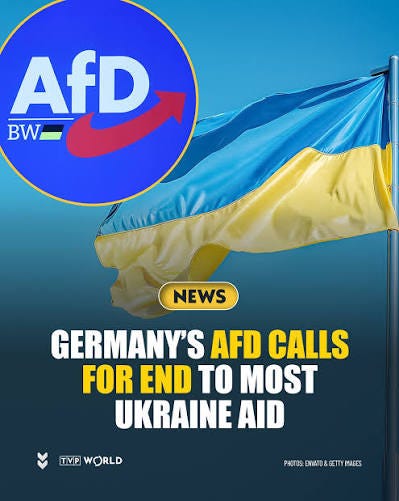
The real black swan - an unlikely but destructive event - is politics. The AfD has been making impressive strides. The AfD is not against a strong Bundeswehr, but it is openly pro-Russian. The party opposes helping Ukraine, rejects sanctions on Moscow and is sceptical of NATO, and an AfD government could keep a large army while turning it away from the threat it is being rebuilt to deter.
Every other party still refuses to govern with the AfD, and the next federal election is in 2029. But German rearmament is a ten-year project, and ten years is long enough for politics to change. A hostile government would not need to repeal anything; it would just need to stop signing contracts. The same parliamentary vote that slows procurement today would then be the tool that halts it. For a founder signing a multi-year framework, that is a risk that sits outside every business plan.
The pressure also comes from the far left. Die Linke, which came first in Berlin on 20 September, opposes rearmament outright and voted against the 2025 reform that freed defense spending from the debt brake. Beyond party politics, left-wing extremists are believed to be behind a string of arson attacks on the defense industry, from a property owned by Rheinmetall’s CEO in 2024 to a fire at Rohde & Schwarz’s Munich headquarters earlier this month.
My verdict
Having made the bear case as hard as I can, I am still very bullish on Germany, both as a defense power and as a place to invest. Three of the four arguments are about friction rather than direction. Certification slows startups down, but the officials running it want them to succeed. The Bundestag votes on every tranche, but so far it has approved them. The Gulf is harder to reach from Berlin than from Paris, but German companies still sell there. None of this changes where European defense money is going, and most of it is going to Germany.
Germany also has the engineers to spend it on. Where France’s strength lies in AI and mathematics, Germany’s lies in applied engineering, especially mechanical and aerospace, and the Technical University of Munich (TUM) is one of the best universities in the world in these fields. Germany also has the production talent. Its manufacturing base runs deep, and Tesla’s gigafactory outside Berlin has added a pool of engineers who have seen great manufacturing done at scale and are available to be poached by startups.
Founders have noticed. Swiss and Dutch founders are setting up in Munich from day one, and foreign startups open German offices as early as they can, most recently Cambridge Aerospace in Munich.
Sensofusion - Finnish counter-drone company whose software is used in Ukraine, the Middle East and by the US Marine Corps - plans to raise about $344M in a Helsinki IPO at a valuation of up to $1.5B.
Fundraises
Tekever - Lisbon-based maker of surveillance drones that sells the intelligence they gather as a subscription - $580M Series D at a $6.4B post-money valuation, co-led by UC Investments and Baillie Gifford, with Merlyn Advisors, Crescent Cove, Ventura Capital and Iberis Capital.
EnduroSat - Bulgarian satellite manufacturer - $205M (€178.7M).
Mesa Quantum - quantum sensing - $11.8M led by Playground Global, with DCVC and J2 Ventures, bringing total funding to nearly $16M.
Radian Forge - maritime-focused advanced manufacturing - $2.5M seed led by Veteran Ventures Capital.
Funds
1789 Capital - growth investor with a large defense portfolio (SpaceX, Anduril Industries, Hadrian, Vulcan Elements) and which counts Donald Trump Jr. as a partner - in talks to raise $3B for a new growth fund.